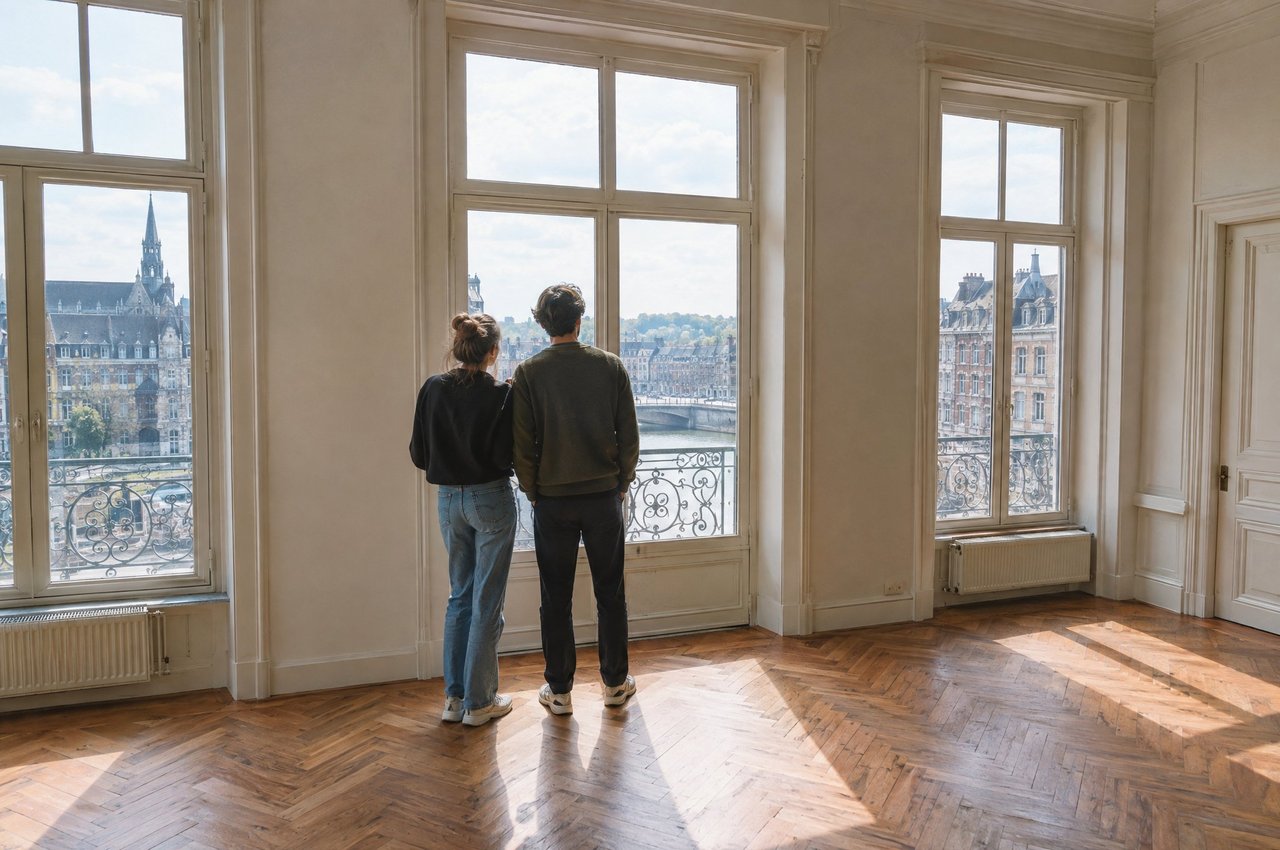
Before you start: define your project
Buying a house is a major decision that deserves careful thought beforehand. Before you start viewing, it helps to clarify a few fundamental points: what type of property are you looking for? In which municipality or area? What is your real budget, not just the purchase price but also the additional costs? What is your time horizon?
These questions seem simple, but answering them honestly saves you from wasting time on properties that do not match your project.
Step 1: assess your borrowing capacity
In Belgium, banks generally require a personal contribution of at least 10 to 20% of the purchase price, on top of the purchase costs. These costs include registration duties (3% in Wallonia for a sole own home since 2025, 12.5% in other cases), notary fees and any agency fees.
Before you start viewing, consult your bank or a mortgage broker to find out your real borrowing capacity. This will stop you falling for properties beyond your budget and allow you to make credible offers.
Step 2: define your search criteria
Once your budget is set, refine your criteria:
- Type of property: 4-facade detached house, villa, town house, flat.
- Minimum living area and number of bedrooms.
- A garden, a garage, a terrace.
- Municipality or geographical area.
- Condition of the property: ready to move into or to renovate.
- Desired EPB class.
Distinguish non-negotiable criteria from desirable ones. This will help you make decisions more quickly during viewings.
Step 3: searching and viewing
You can search through property portals, local agencies and word of mouth. In the Province of Liège, some high-quality properties are not advertised on mainstream portals. Being in touch with local agencies active in the segment you are targeting can make the difference.
During viewings, pay attention to the overall condition of the property, the natural light, the orientation, any nuisance, and the state of the roof and installations. Do not hesitate to ask about works carried out, running costs and the planning situation.
Step 4: make an offer
When a property suits you, you can make a purchase offer. In Belgium, an offer accepted by the seller is in principle binding. So be sure of your decision before making an offer.
The offer can be at the asking price or below it. It can be subject to conditions precedent, in particular obtaining a mortgage. Consult your notary or your agency before making an offer to make sure the conditions are properly worded.
Step 5: the sales agreement (compromis)
The sales agreement is the contract that definitively binds both parties. It is generally signed a few weeks after the offer has been accepted. It sets out the terms of the sale: price, deadline for signing the deed, any conditions precedent.
When the sales agreement is signed, the buyer generally pays a deposit of 10% of the sale price. The notary holds this deposit until the deed of sale is signed.
Step 6: the deed of sale
The deed of sale is signed at the notary's office, generally two to four months after the sales agreement. This is when ownership is officially transferred and the balance of the price is paid. The purchase costs (registration duties, notary fees) are also settled at this stage.
What YOUHOME offers buyers
YOUHOME supports buyers in their search for high-quality residential properties in the Province of Liège. This includes a selection of properties suited to the project, support during viewings and follow-up until the deed is signed.