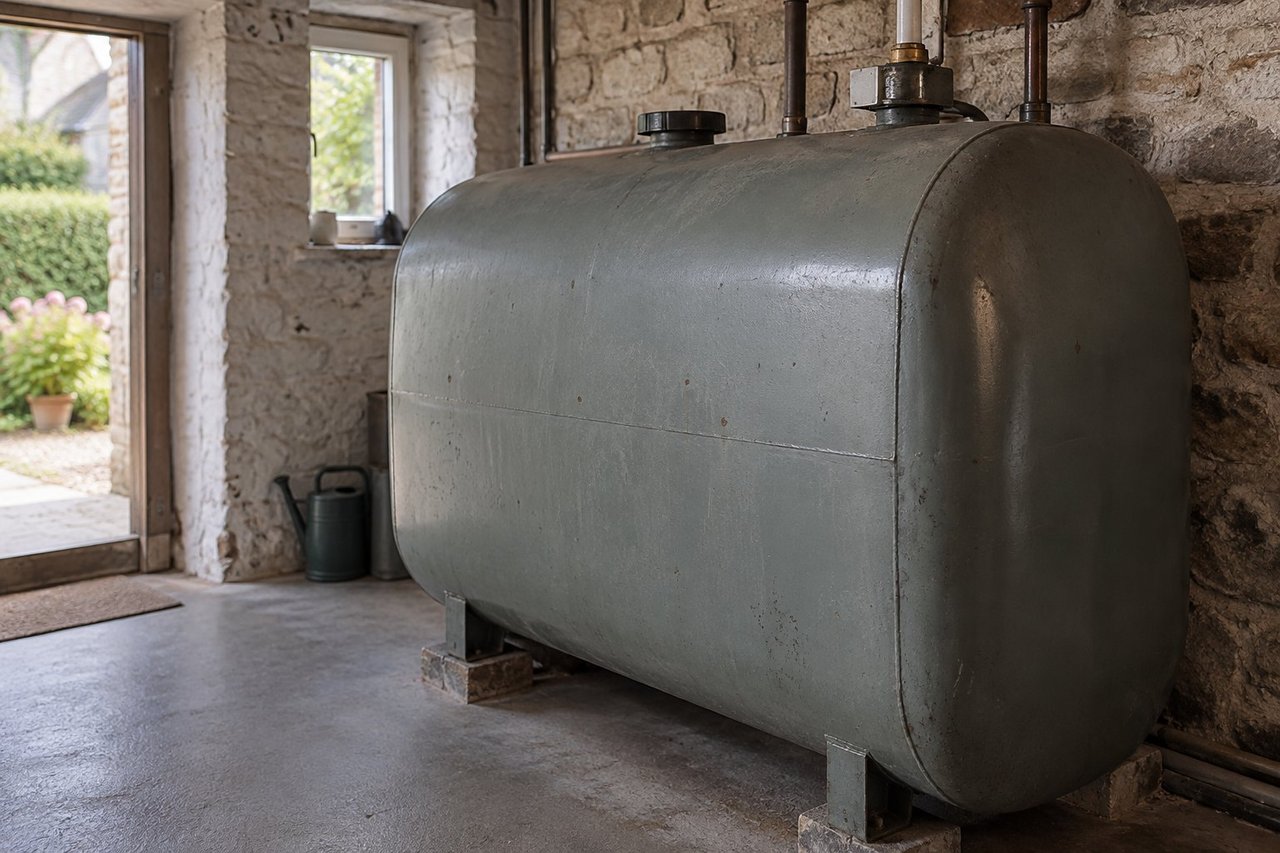
Your heating oil tank file should establish its capacity and location, its inspections and the work carried out. A boiler servicing invoice does not document these details. Before selling in Wallonia, distinguish missing records from defects actually identified: the former call for a search, the latter for a technical response and a quotation.
Which records should you look for first?
Organise the available records into four groups:
- Identification: manufacturer, year, capacity, material, number of walls and location, with a legible photograph of the identification plate and any available invoices.
- Formalities: declaration to the municipality or environmental permit, where the storage installation requires one.
- Inspections: full reports, conclusions, expiry dates and evidence of repairs.
- Any decommissioning: certificates for the operations and removal of residues, followed by removal of the tank or filling with inert material.
This filing method does not mean that every document is compulsory for every installation. The Walloon Order, articles 20 and 46, describes the identification file and exemptions concerning certain historical documents for existing installations. First find what exists, then have the applicable obligations clarified.
How do you check which rules apply to your tank?
The official SPW guidance states that storage of 3 000 to 24 999 litres falls within class 3, requiring a declaration and periodic inspections. From 25 000 litres, an environmental permit is required. Capacity means the total volume of the storage tanks, not the oil remaining.
Below 3 000 litres, the SPW recommends its prevention rules; requirements also apply in drinking water abstraction protection zones. Ask the municipality or the SPW to check the zoning. Without proof of actual capacity, the SPW treats storage as exceeding 3 000 litres and subject to declaration and inspection. A visual estimate is therefore insufficient.
A tank in a cellar may be classified as "above ground". A tank partly in contact with earth or backfill may be classified as "underground". These definitions appear in article 2 of the Order cited: location, accessibility and protective measures matter as much as the number of walls.
What should you read in the inspection report?
Match the report to the correct tank: identification, address, date, result, qualifications and next due date. Under articles 34, 43 and 46 of the Order, inspection frequency varies with factors including the type, age, protective measures and status of the installation. Have an inconsistent due date confirmed by a technician approved in Wallonia.
Article 19bis provides for a green tag for a leak-tight and compliant installation, orange where remedial work is needed, and red where there is a lack of leak-tightness. Filling under an orange tag is limited to a maximum of six months without renewal; a red tag prohibits filling. Article 46 specifies how this applies to existing installations. An old tag therefore does not prove current compliance.
What should you keep after changing your heating system?
A replaced boiler does not prove that the old tank has been decommissioned. Under the Order's rules, articles 33 and 42 require emptying, degassing, cleaning and removal; for an underground tank, filling with inert material applies if removal is impossible. Pipework must be emptied and dismantled.
For an underground tank, article 45 lists certificates for degassing, removal of residues and removal of the tank or filling with inert material. The latter states the material and quantity used. For a small storage installation, have its specific requirements clarified. Request a detailed quotation before the work: access, volume, removal and any groundworks prevent a reliable cost being given without examination.
Which questions arise before a sale?
Does a sale always require a new inspection?
Do not assume this is a universal obligation. The sometimes cited 2019 rules were repealed by the Order of 23 April 2020. Operating obligations still apply. The technician and notary will clarify the records and steps needed in your situation.
What if the certificate cannot be found?
Ask the previous service provider for a duplicate. If that fails, give the available information to the technician to determine the necessary checks and their cost by quotation. A missing document does not, on its own, amount to a diagnosis of a leak.
Should you work on an unused tank yourself?
Do not confuse organising records with a technical intervention. Have competent professionals determine the operations and residue management, then keep their certificates. A vague invoice for "heating works" does not describe what was done to the tank.
To organise the rest of your project, read our article on preparing a sale in Wallonia. Would you like to put these checks into the context of your home's value and timetable? Let us discuss your sale and valuation project.